An Espadín agave grows for five to nine years before it is cut, roasts three to five days in a wood-fired earth pit, ferments for days in open wooden vats and is distilled twice. Ten kilos of agave become one litre of mezcal. The whole process, from the field to the bottle, takes about two weeks once the plant is out of the ground, and every stage happens in plain view at a palenque.
Below is the sequence in the order you will see it on a distillery visit, with the numbers that matter.
1. Growing and harvesting the agave
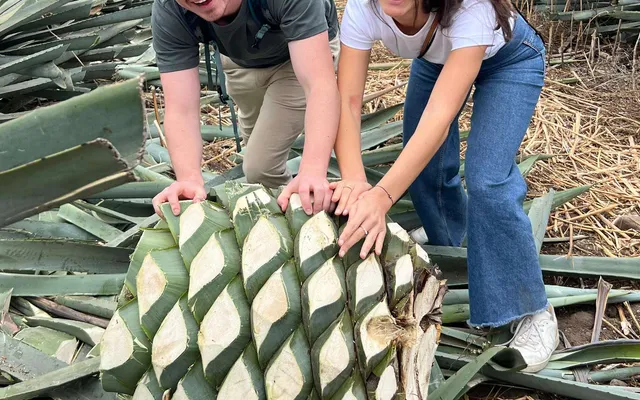
Agaves flower once and die, so the mezcalero cuts the plant just before it sends up its flower stalk, when sugar in the heart is highest. Years to that point vary by species, per Difford’s Guide: Espadín 5–9, Madrecuishe 9–20, Tobalá 10–15, Barril 12–15, Arroqueño 20–25, Tepeztate 25–35.
The jimador strips the leaves with a coa, a flat blade on a pole, leaving the piña. An Espadín piña weighs about 70 kg (Mezcalistas); a Tobalá piña about 15 kg. That gap is the reason wild-agave bottles cost more.
The Mezcal Journey (6 h, from $104, 4.8★ from 111 reviews) begins with a walk through the agave rows at Campo Enigma before three hours at an artisanal distillery, so the day follows the same order as this page.
Book a mezcal experience
The Mezcal Journey
From $104 per person
6 hours · English, Spanish · Up to 12 · Free cancellation
One or two palenques near Santiago Matatlán, agave fields, tastings and an Oaxacan lunch. Transport leaves from a city meeting point; listed group maximum 12.
Mezcal Tour Oaxaca (13 Tastes)
From $101 per person
5 hours · English · Free cancellation
Production and agave visit in the Matatlán/Tlacolula area, with up to 13 mezcals. English is the listed language.
2. Cooking: three to five days in the pit
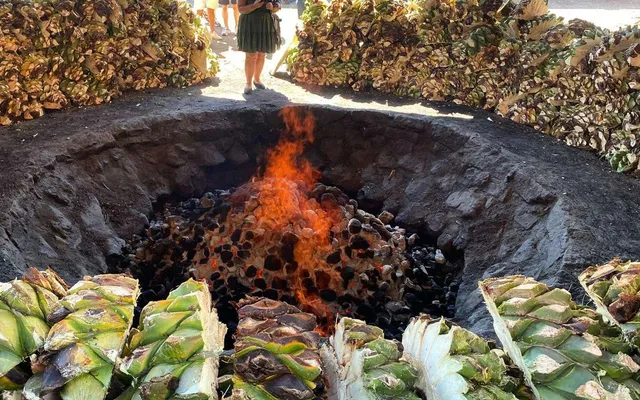
The piñas are halved or quartered and stacked in a conical pit dug into the ground, on top of river stones that have been heated by a wood fire. The pile is covered with agave fibre, mats and earth and left to roast for three to five days (Difford’s, production). Heat converts the plant’s inulin into fermentable sugars; the smoke and the wood are what give mezcal its signature.
Masonry ovens above ground do the same job with less smoke; stainless autoclaves do it in hours. Under NOM-070 the pit is compulsory for the Ancestral category, pit or masonry for Artesanal, and any of the three for plain Mezcal (NOM-070, 4.4).
When the pit is opened the agave is dark amber, sticky and sweet. Most palenques let visitors chew a piece.
3. Milling: horse, stone or mallet
Cooked agave has to be crushed before it can ferment. The classic tool is the tahona, a stone wheel of a tonne or more pulled in a circle by a horse or mule. Smaller Ancestral producers pound the agave by hand with wooden mallets in a hollowed trunk; industrial plants use mechanical shredders. Whether the tahona in the yard is turning on the day you visit depends on where the batch is in its cycle, not on the tour.
4. Fermentation: open vats, wild yeast, days not hours
The crushed agave, fibre included, goes into open wooden vats called tinas, sometimes stone tanks, clay pots or cowhide. Water is added, and airborne yeast does the rest. Fermentation runs from several days to a couple of weeks depending on the temperature (Difford’s); it is faster in the hot valley towns around Santiago Matatlán than in the hills.
Nothing is added. NOM-070 requires the agave fibre to stay in the vat for Ancestral mezcal and allows it for Artesanal, which is why village mezcal tastes of the plant rather than of a distillery.
5. Distillation: twice, in copper or clay
The fermented mash, fibre and all, goes into a small still heated by direct fire. The first pass gives an ordinario of around 20% alcohol; the second pass brings it to bottling strength (Difford’s). Artesanal producers use copper alembics or clay pots; Ancestral producers may use only clay pots with a clay or wooden cap (NOM-070, 4.4.3).
The mezcalero cuts the run by taste and by perlas, the beads that form when the spirit is poured into a jícara: the way they hold is a rough gauge of strength. The result is bottled young at whatever the batch delivers inside the legal 35–55% range; Alipús San Andrés is sold at 48% (Vinos y Licores).
6. What comes out
The arithmetic from Mezcalistas: 10 kg of Espadín per litre, so one 70 kg piña yields about seven litres; a four-tonne pit load gives roughly 320 litres, or about 425 bottles of 750 ml. A single Tobalá piña makes about one litre.
Put those numbers against the shop prices and they line up. Real Minero sells its clay-pot Espadín for MXN 2,031 and its Tobalá capón for MXN 2,615 (Real Minero shop); Mezcal Vago’s Espadín is MXN 850 and its Tepeztate–Espadín ensamble MXN 1,700 (Vago shop).
The three categories, stage by stage
| Stage | Mezcal | Artesanal | Ancestral |
|---|---|---|---|
| Cooking | Pit, masonry oven or autoclave | Pit or masonry oven | Earth pit only |
| Milling | Shredder, mill or tahona | Tahona, mill, trapiche, shredder or mallet | Mallet, tahona or Chilean mill |
| Fermentation | Wood, stone, concrete or steel | Wood, stone, clay, earth or hide; fibre optional | Same vessels; fibre required |
| Still | Copper, steel or column | Direct-fire copper or clay | Direct-fire clay pot |
Source: NOM-070-SCFI-2016.
What you see on a palenque visit
The Mezcal Journey runs a van 50 minutes out of the city, 30 minutes among the agaves, three hours at the distillery with tasting straight from the still, then lunch at Doña Chica before the hour back. Reviewers keep landing on the same point: “Got to see the whole production process from start to finish on a real working distillery”, wrote John from the United Kingdom in February 2026 about the five-hour Mezcal Tour Oaxaca (from $101, 4.7★ from 60 reviews), which adds an agave plantation and a pulquería stop.
Both leave from the Centro, and both end with more mezcal than most people expect: the Journey’s tasting is unlimited, and lunch is included. Read the route guide for the villages themselves, Mezcal 101 for the vocabulary and the brands guide for what to bring home.